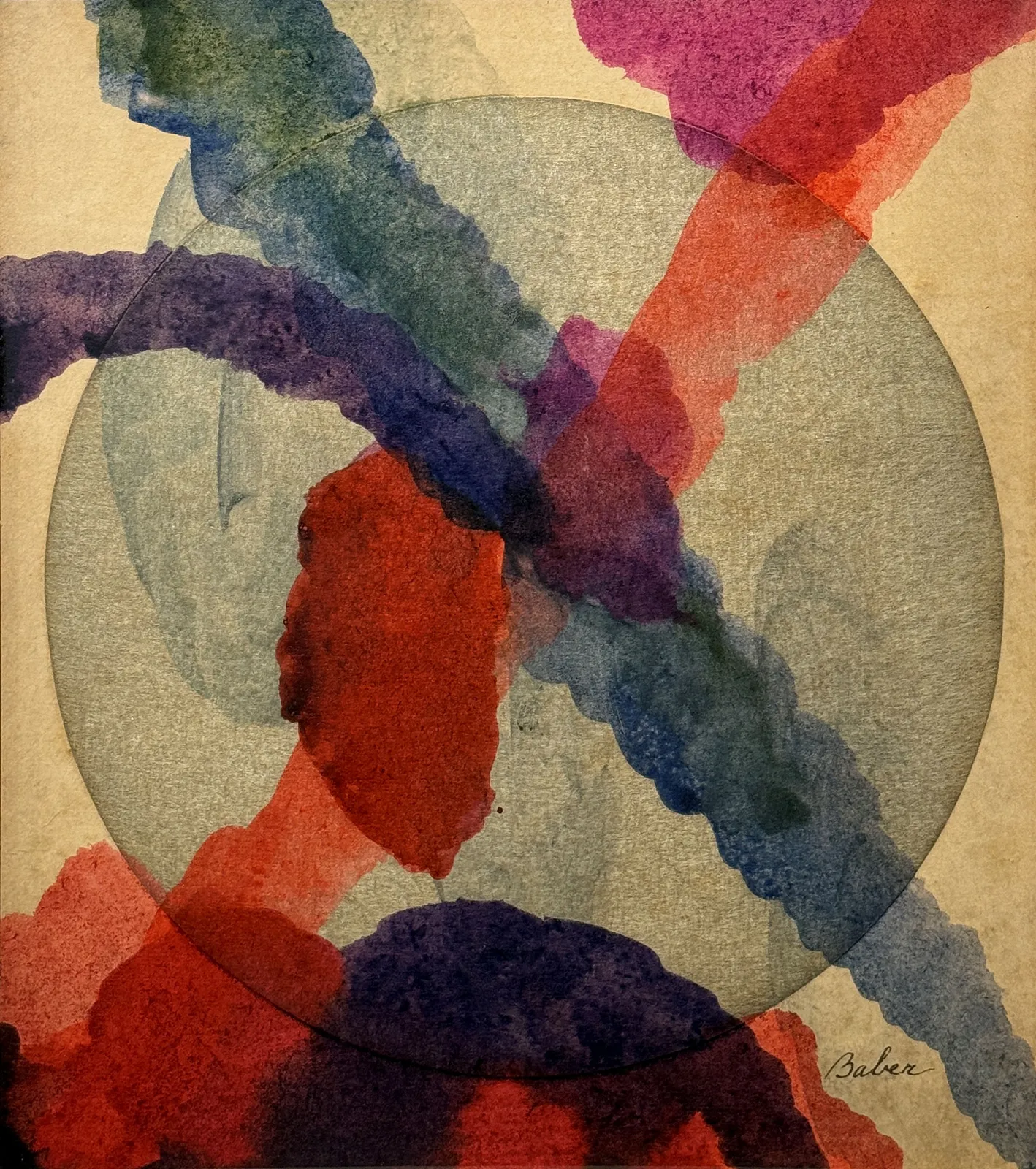
Alice Baber American, 1928-1982
Alice Baber’s Across the Wide, Tokyo (1964) stands as
an intimate and luminous meditation on movement, cultural encounter, and
abstraction at a pivotal moment in the artist’s career. Created during Baber’s
travels in Japan, the small watercolor and leaf collage on paperboard possesses
a remarkable sense of expansiveness despite its modest scale. The work combines
translucent washes of saturated color with delicate collage elements, allowing
overlapping forms to float weightlessly across the surface. Through these
layered passages of violet, crimson, blue, and muted green, Baber achieved the
atmospheric luminosity that would come to define her mature practice.
The painting emerged from a transformative period in Baber’s
life and artistic development. By the early 1960s, Baber had established
herself as one of the leading women associated with postwar American
abstraction. Unlike many of her contemporaries in Abstract Expressionism, whose
works often emphasized gesture, aggression, or existential weight, Baber
pursued a more lyrical and transcendent visual language. Her paintings
frequently explored light, rhythm, and spiritual openness through overlapping
veils of color. Travel became central to this vision. Throughout the 1950s and
1960s, Baber journeyed extensively across Europe, North Africa, and Asia,
absorbing artistic traditions and cultural philosophies that expanded her
understanding of abstraction as a universal language.
Central to Baber’s artistic and personal life during this
period was her relationship with fellow painter Paul Jenkins. The two artists
married in 1964, the same year Across the Wide, Tokyo was created, and
their partnership represented one of the most significant intellectual and
creative dialogues within postwar American abstraction. Though each maintained
a highly individual style, Baber and Jenkins shared a profound interest in
color, spontaneity, and the spiritual potential of abstract painting. Jenkins’
flowing poured compositions and Baber’s radiant atmospheric forms both rejected
rigid geometry in favor of intuitive movement and emotional resonance. Their
shared travels abroad, particularly through Europe and Asia, exposed them to
diverse artistic traditions and philosophies that deeply informed their
practices.
Japan proved especially significant for Baber. During her
1964 visit, she immersed herself in Japanese art, aesthetics, and daily life,
experiences that deeply informed Across the Wide, Tokyo. The
composition’s prominent circular form recalls both celestial imagery and the
restrained geometry found in Japanese design traditions. At the same time, the
floating transparency of the watercolor evokes the delicacy of Japanese screens
and ink painting, where atmosphere and emptiness carry as much meaning as form
itself. Rather than imposing structure onto the composition, Baber allowed
color to breathe and drift, creating a sensation of openness and meditation.
The painting also reflects the emotional complexity of this
period in Baber’s life. Contemporary accounts note that the Japan trip occurred
during moments of tension within her marriage to Jenkins, whose forceful
personality and growing reputation often overshadowed Baber’s own achievements
within the male-dominated art world. Yet rather than conveying conflict
directly, Across the Wide, Tokyo transforms personal experience into a
lyrical meditation on balance, movement, and emotional resilience. The work’s
layered transparency and intersecting forms suggest both intimacy and distance,
connection and independence.
The title itself, Across the Wide, suggests both
physical and emotional distance. It evokes transpacific travel, cross-cultural
exchange, and the expansive possibilities of modern abstraction. Baber’s time
in Tokyo exposed her to a broader international artistic dialogue at a moment
when postwar art was becoming increasingly global. The work therefore functions
not merely as a travel-inspired composition, but as a meeting point between American color abstraction and Japanese
spatial sensitivity.
Ultimately, Across the Wide, Tokyo encapsulates many
of the qualities that make Alice Baber’s work so singular: luminosity,
emotional openness, and a profound sensitivity to color as a living force.
Though modest in scale, the work achieves an extraordinary sense of breadth and
serenity, transforming watercolor and collage into an experience of movement,
light, and cultural discovery. It remains a deeply poetic example of Baber’s
ability to merge personal experience with universal abstraction while asserting
an independent artistic voice alongside one of the most prominent painters of
her generation.


