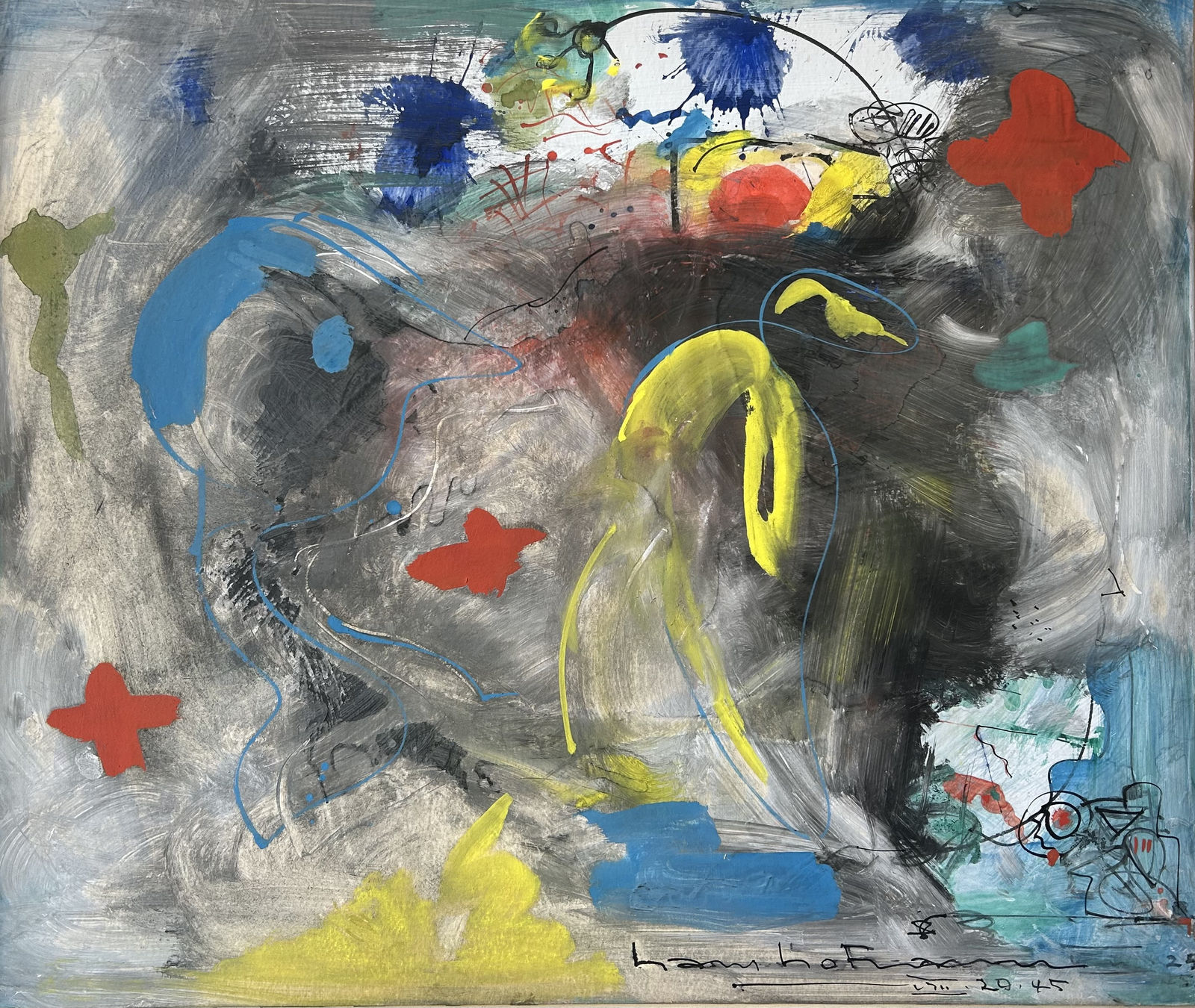

Hans Hofmann American, 1880-1966
Untitled, 1945
Oil and gouache on paperboard
22 x 25 3/4 inches
Signed and dated lower right


This work by Hans Hofmann was created in the pivotal year of 1945, a decisive and transformative moment in the artist’s career when critical recognition, personal upheaval, and artistic breakthrough...
This work by Hans Hofmann was created in the pivotal year of 1945, a decisive and transformative moment in the artist’s career when critical recognition, personal upheaval, and artistic breakthrough converged. His solo exhibition at Howard Putzel’s 67 Gallery in New York, opening on April 2, signaled his growing authority within the American avant-garde. Clement Greenberg’s review—declaring Hofmann “a force to be reckoned with in the practice as well as in the interpretation of modern art”—firmly positioned him not only as a painter of consequence but also as a leading intellectual voice in abstraction. His inclusion later that spring in the group exhibition A Problem for Critics further underscored his central role in shaping the evolving discourse around modern painting. At the same time, Hofmann was navigating significant transitions in his working environment, relocating both his New York studio and his Provincetown teaching operations, laying the groundwork for a more permanent and influential presence in both locations.
Yet the year was equally defined by profound emotional and historical shock. Works from this moment, such as the present painting, embody a heightened sense of urgency and intensity: sweeping gestural passages collide with bursts of saturated color, while calligraphic lines and painterly smears create a dynamic tension between structure and spontaneity. The surface feels at once constructed and explosive, reflecting an artist grappling with the psychological and cultural aftermath of World War II. This fusion of emotional immediacy and formal innovation would become a defining characteristic of Hofmann’s practice.
By the end of 1945, Hofmann’s inclusion in the Whitney Annual, where his painting Idolatress was exhibited, marked his entry into the art world's formal institutional framework, accompanied by increasingly positive critical reception. Notably, Hilda Loveman’s early use of the term “abstract expressionist” in response to the tendencies emerging in such works signals the formation of a new critical language around artists like Hofmann. At the same time, he was preparing for his 1946 exhibition at the Mortimer Brandt Gallery, where Robert Coates would famously coin the term “Abstract Expressionism” in direct response to Hofmann’s work. This work stands at a crucial threshold of when Hofmann emerged as a central figure in defining Abstract Expressionism.
Yet the year was equally defined by profound emotional and historical shock. Works from this moment, such as the present painting, embody a heightened sense of urgency and intensity: sweeping gestural passages collide with bursts of saturated color, while calligraphic lines and painterly smears create a dynamic tension between structure and spontaneity. The surface feels at once constructed and explosive, reflecting an artist grappling with the psychological and cultural aftermath of World War II. This fusion of emotional immediacy and formal innovation would become a defining characteristic of Hofmann’s practice.
By the end of 1945, Hofmann’s inclusion in the Whitney Annual, where his painting Idolatress was exhibited, marked his entry into the art world's formal institutional framework, accompanied by increasingly positive critical reception. Notably, Hilda Loveman’s early use of the term “abstract expressionist” in response to the tendencies emerging in such works signals the formation of a new critical language around artists like Hofmann. At the same time, he was preparing for his 1946 exhibition at the Mortimer Brandt Gallery, where Robert Coates would famously coin the term “Abstract Expressionism” in direct response to Hofmann’s work. This work stands at a crucial threshold of when Hofmann emerged as a central figure in defining Abstract Expressionism.