

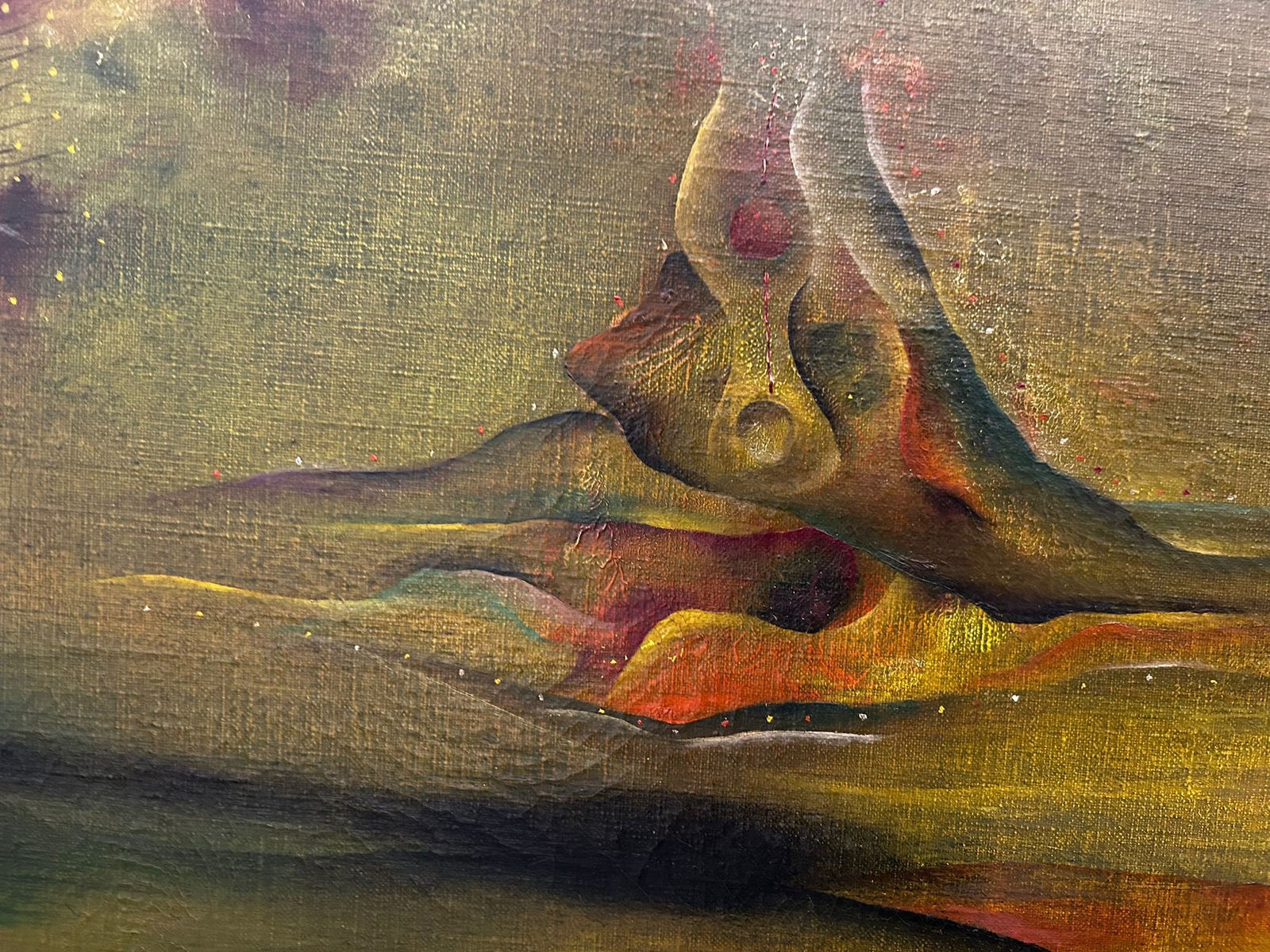
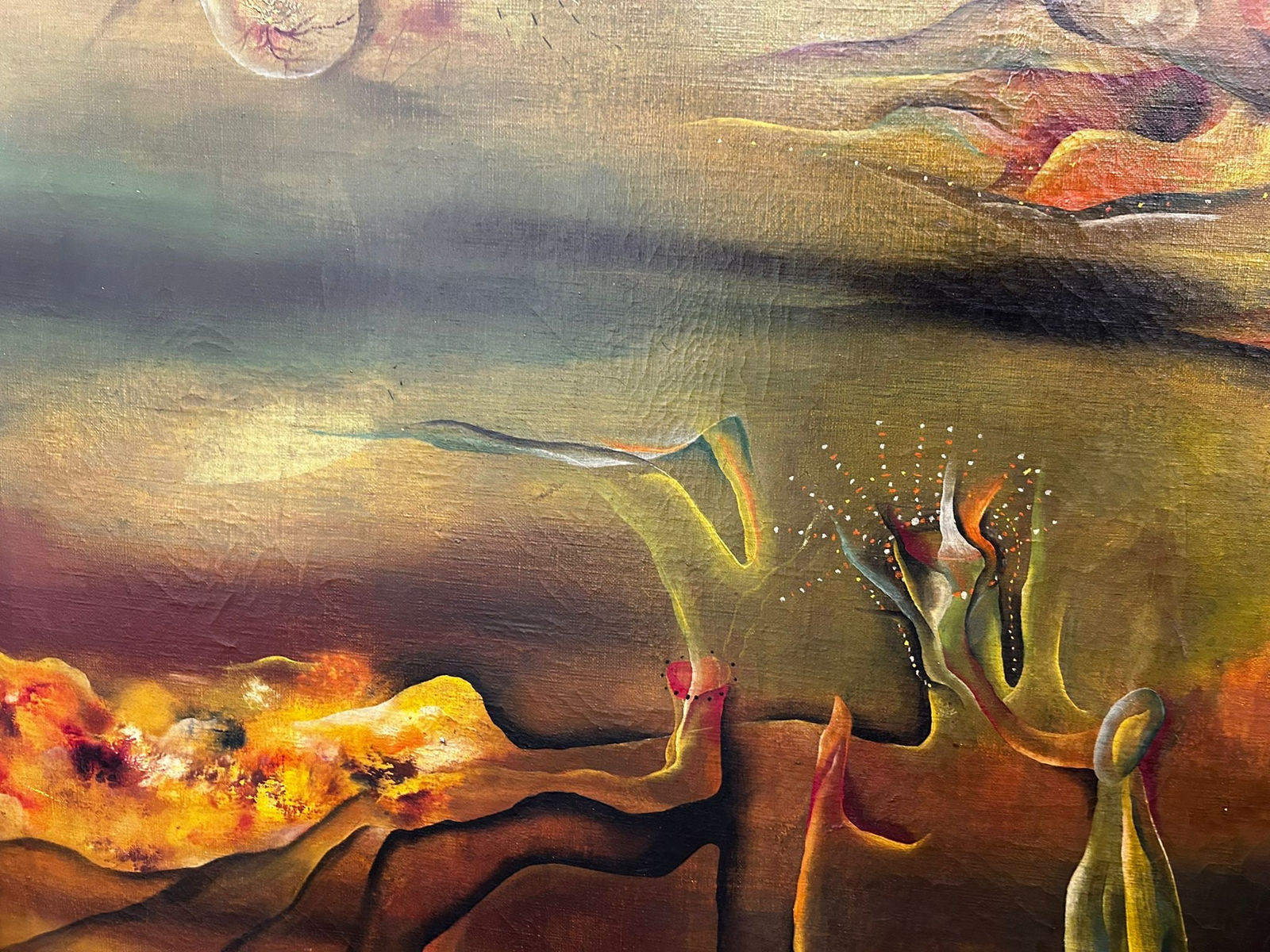
Gerome Kamrowski American, 1914-2004
Untitled, circa 1944
Oil on canvas
35 3/4 inches x 47 3/4 inches
Signed on the reverse and inscribed "St. Mary's / Georgia"
Further images


This painting was likely created during Gerome Kamrowski’s 1944 winter residence in St. Marys, Georgia, a period documented both by the inscription on the reverse (“G. Kamrowski / St. Marys...
This painting was likely created during Gerome Kamrowski’s 1944 winter residence in St. Marys, Georgia, a period documented both by the inscription on the reverse (“G. Kamrowski / St. Marys Georgia”) and by the artist’s own handwritten autobiographical notes. In his 1986 interview with Martica Sawin, Kamrowski recalled that during his Guggenheim Fellowship he “went down south for the winter” and briefly held “some sort of job managing a chicken ranch” to supplement his stipend. This southern stay took place during a period of significant personal activity. In 1943 he married Marianna Fargione, contributed two illustrations to the Surrealist periodical VVV, and spent the summer in Woodstock. VVV was edited by André Breton, Marcel Duchamp, and David Hare, and Kamrowski’s participation placed him among the younger American artists actively engaged with the European Surrealists who had taken refuge in New York at the time.
By 1944 Kamrowski was part of a dynamic network that included European figures such as Matta and Wifredo Lam, as well as a core group of American artists who were developing new experimental approaches. These included Jackson Pollock, William Baziotes, Robert Motherwell, Arshile Gorky, Jimmy Ernst, and Robert De Niro Sr., all of whom Kamrowski knew personally or worked alongside in shared studios, classes, or informal sessions of collaborative drawing and painting. This environment of exchange and proximity formed much of the artistic world to which he returned after his winter in St. Marys. The winter in Georgia also coincided with the birth of his first son Felix, which Kamrowski later described as unintentional. In 1945 his wife Marianna died, marking the end of a brief but eventful chapter in his early career.
The painting appears in an installation photograph from Kamrowski’s 1946 one-person exhibition at the Mortimer Brandt Gallery in New York, which confirms its completion before that exhibition. At the time the modern division of the gallery was managed by Betty Parsons, who soon established her own gallery that became an important venue for many of the emerging Abstract Expressionists, including Kamrowski, who held a one-person exhibition there in 1948. Kamrowski’s presence in the 1946 Brandt exhibition places the work within the group of paintings that first introduced him to New York audiences. Although he returned to St. Marys in a later painting, Sunrise Pagan Bluff (St. Marys, Georgia) of 1958, this 1944 canvas reflects the earliest period in which that location played a direct role in his work, produced during a time of geographic movement, personal change, and sustained artistic exchange.
By 1944 Kamrowski was part of a dynamic network that included European figures such as Matta and Wifredo Lam, as well as a core group of American artists who were developing new experimental approaches. These included Jackson Pollock, William Baziotes, Robert Motherwell, Arshile Gorky, Jimmy Ernst, and Robert De Niro Sr., all of whom Kamrowski knew personally or worked alongside in shared studios, classes, or informal sessions of collaborative drawing and painting. This environment of exchange and proximity formed much of the artistic world to which he returned after his winter in St. Marys. The winter in Georgia also coincided with the birth of his first son Felix, which Kamrowski later described as unintentional. In 1945 his wife Marianna died, marking the end of a brief but eventful chapter in his early career.
The painting appears in an installation photograph from Kamrowski’s 1946 one-person exhibition at the Mortimer Brandt Gallery in New York, which confirms its completion before that exhibition. At the time the modern division of the gallery was managed by Betty Parsons, who soon established her own gallery that became an important venue for many of the emerging Abstract Expressionists, including Kamrowski, who held a one-person exhibition there in 1948. Kamrowski’s presence in the 1946 Brandt exhibition places the work within the group of paintings that first introduced him to New York audiences. Although he returned to St. Marys in a later painting, Sunrise Pagan Bluff (St. Marys, Georgia) of 1958, this 1944 canvas reflects the earliest period in which that location played a direct role in his work, produced during a time of geographic movement, personal change, and sustained artistic exchange.
Join our mailing list
* denotes required fields
We will process the personal data you have supplied in accordance with our privacy policy (available on request). You can unsubscribe or change your preferences at any time by clicking the link in our emails.