Ida Kohlmeyer American, 1912-1997
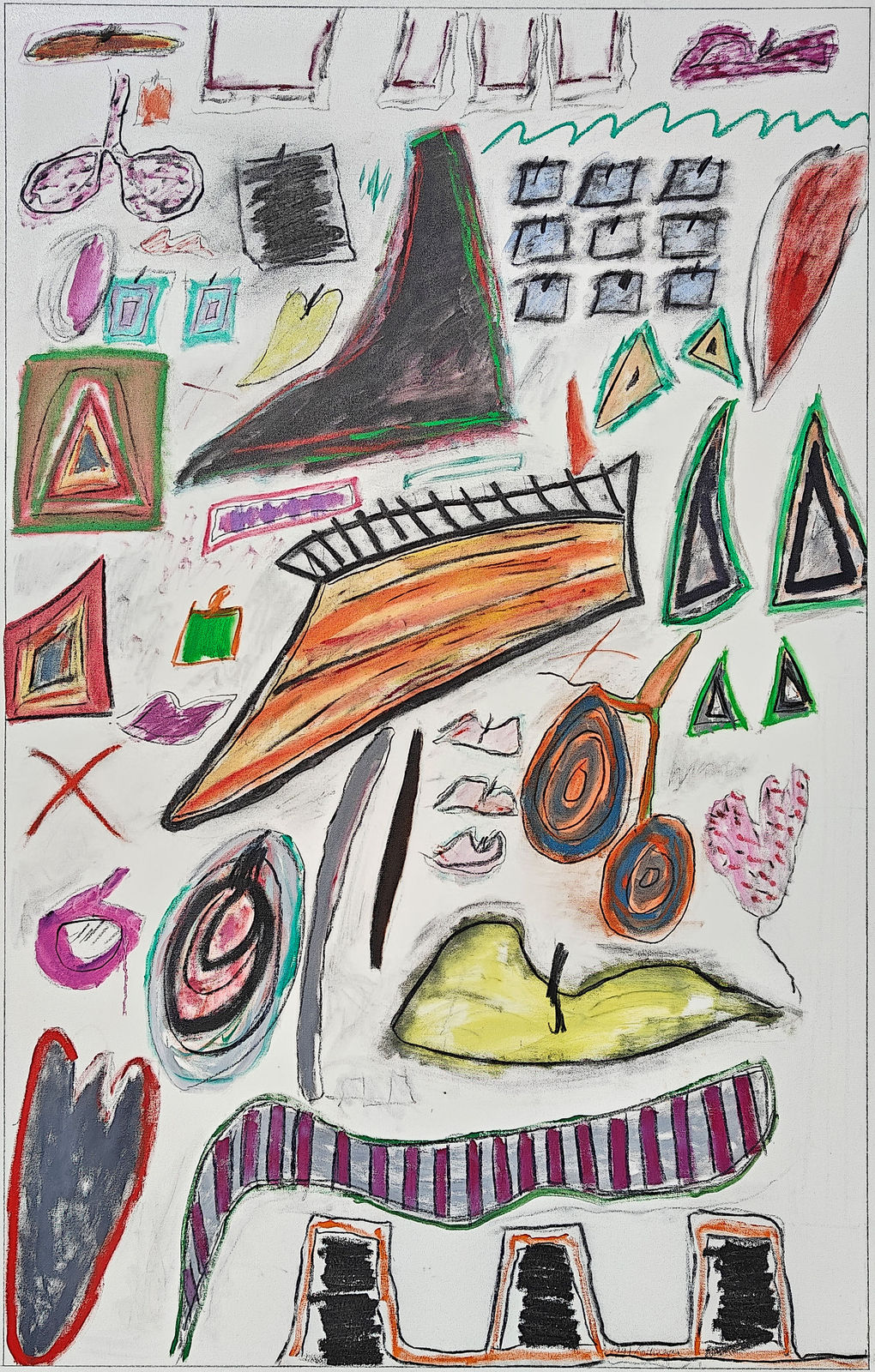
Semiotic 91-C, 1991
Mixed media on canvas
78 x 52 3/4 inches
Signed and dated lower right
Created in 1991, Semiotic 91-C exemplifies Ida Kohlmeyer’s mature visual language, a highly personal synthesis of abstraction, symbolism, and lyrical mark-making. Throughout her career, Kohlmeyer developed a vocabulary of recurring...
Created in 1991, Semiotic 91-C exemplifies Ida Kohlmeyer’s mature visual language, a highly personal synthesis of abstraction, symbolism, and lyrical mark-making. Throughout her career, Kohlmeyer developed a vocabulary of recurring signs, geometric forms, and biomorphic motifs that seem to hover between written language and pure abstraction. Rather than conveying a fixed meaning, these symbols function as a visual lexicon through which the artist explored rhythm, intuition, and spiritual experience.
In Semiotic 91-C, the composition unfolds across a luminous white ground populated by floating forms that evoke fragments of an unknown alphabet. Triangles, concentric circles, grids, organic shapes, and gestural markings are dispersed across the canvas in a manner that appears spontaneous yet carefully orchestrated. Bold outlines and vibrant accents of magenta, orange, turquoise, green, and black animate the surface, creating a dynamic interplay between structure and improvisation. The work invites the viewer to search for connections among its symbols, much as one might attempt to decipher an unfamiliar script.
The title itself points toward Kohlmeyer’s longstanding interest in signs and systems of communication. By the 1990s, she had refined a visual language that drew upon diverse influences, including ancient pictographs, tribal art, calligraphy, and modernist abstraction. Yet her imagery remains distinctly her own, resisting literal interpretation in favor of emotional and intuitive engagement. The canvas becomes a site where meaning is suggested rather than declared, allowing viewers to construct their own associations among the forms.
A central figure in the development of postwar abstraction in the American South, Kohlmeyer was associated with the New Orleans art community while maintaining a national reputation. She studied with Hans Hofmann in Provincetown in the 1950s, an experience that reinforced her commitment to color, structure, and the expressive possibilities of abstraction. While Hofmann's influence can be felt in her sensitivity to color relationships and compositional balance, Kohlmeyer ultimately forged a highly individual style that merged modernist principles with a fascination for symbolic imagery and mythic forms.
Semiotic 91-C demonstrates the confidence and freedom of Kohlmeyer’s late career. The work balances playfulness and sophistication, spontaneity and order, transforming the canvas into a field of signs that seem simultaneously ancient and contemporary. It stands as a compelling example of the artist’s enduring exploration of visual language and her unique contribution to American abstraction.
In Semiotic 91-C, the composition unfolds across a luminous white ground populated by floating forms that evoke fragments of an unknown alphabet. Triangles, concentric circles, grids, organic shapes, and gestural markings are dispersed across the canvas in a manner that appears spontaneous yet carefully orchestrated. Bold outlines and vibrant accents of magenta, orange, turquoise, green, and black animate the surface, creating a dynamic interplay between structure and improvisation. The work invites the viewer to search for connections among its symbols, much as one might attempt to decipher an unfamiliar script.
The title itself points toward Kohlmeyer’s longstanding interest in signs and systems of communication. By the 1990s, she had refined a visual language that drew upon diverse influences, including ancient pictographs, tribal art, calligraphy, and modernist abstraction. Yet her imagery remains distinctly her own, resisting literal interpretation in favor of emotional and intuitive engagement. The canvas becomes a site where meaning is suggested rather than declared, allowing viewers to construct their own associations among the forms.
A central figure in the development of postwar abstraction in the American South, Kohlmeyer was associated with the New Orleans art community while maintaining a national reputation. She studied with Hans Hofmann in Provincetown in the 1950s, an experience that reinforced her commitment to color, structure, and the expressive possibilities of abstraction. While Hofmann's influence can be felt in her sensitivity to color relationships and compositional balance, Kohlmeyer ultimately forged a highly individual style that merged modernist principles with a fascination for symbolic imagery and mythic forms.
Semiotic 91-C demonstrates the confidence and freedom of Kohlmeyer’s late career. The work balances playfulness and sophistication, spontaneity and order, transforming the canvas into a field of signs that seem simultaneously ancient and contemporary. It stands as a compelling example of the artist’s enduring exploration of visual language and her unique contribution to American abstraction.
Join our mailing list
* denotes required fields
We will process the personal data you have supplied in accordance with our privacy policy (available on request). You can unsubscribe or change your preferences at any time by clicking the link in our emails.