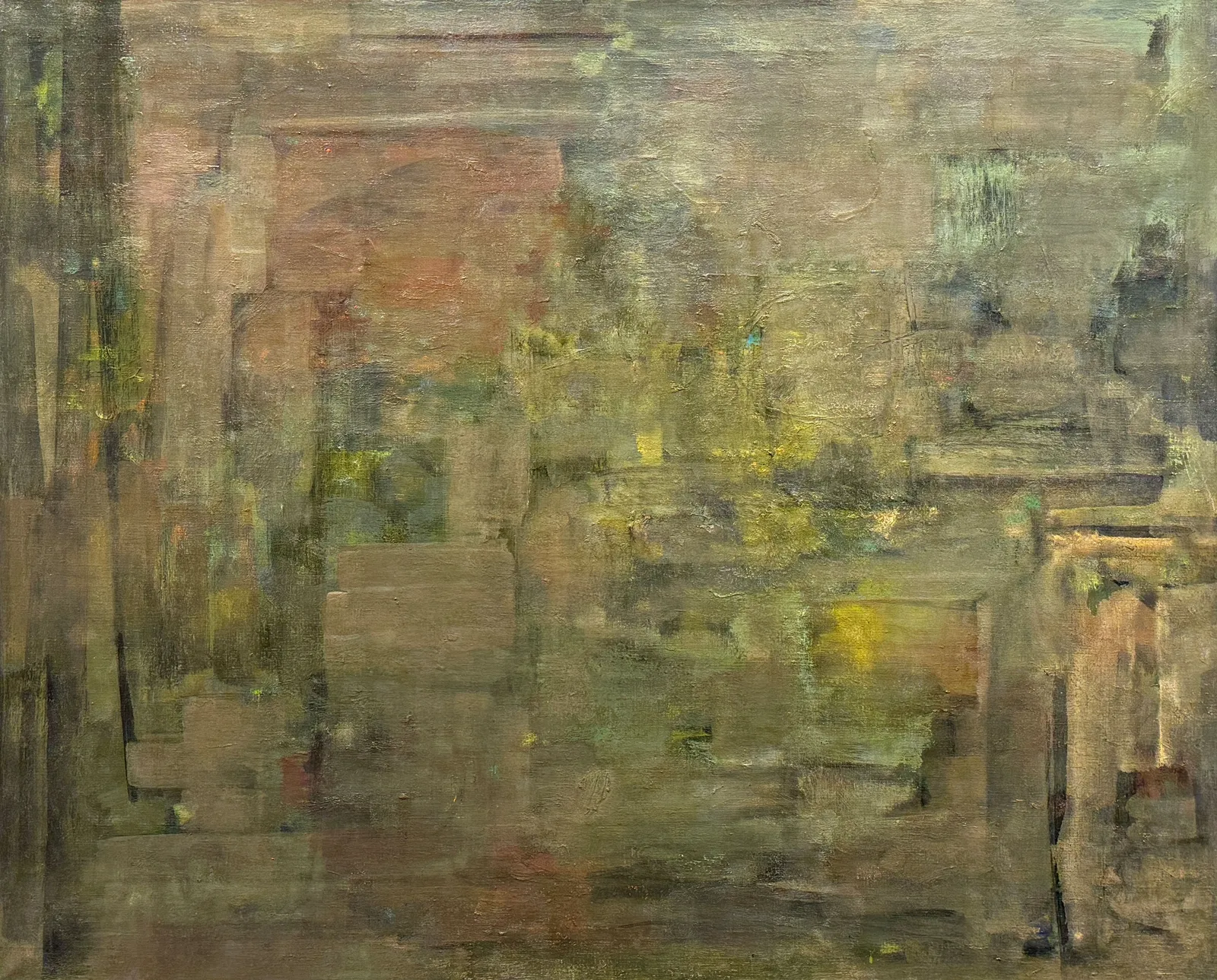

Ad Reinhardt American, 1913-1967


Ad Reinhardt’s Untitled, 1947 occupies a pivotal position in the artist’s development from geometric abstraction toward the severe chromatic reduction of his mature “black paintings.” The work belongs to a transitional moment in postwar American painting when the language of European modernism was being reconfigured into an autonomous American abstraction.
Although Reinhardt would later become synonymous with monochrome austerity, his paintings of the mid-1940s reveal a restless engagement with Cubism, collage, and all-over compositional structures. The composition appears as an interlocking field of angular fragments, muted tonal planes, and compressed spatial intervals. Rather than presenting a centralized motif, the painting disperses attention evenly across the canvas surface. This “all-over” organization, later associated with painters such as Jackson Pollock, was already emerging in Reinhardt’s work as a method of suppressing hierarchy and narrative emphasis.
The painting’s fractured geometry recalls late Analytic Cubism, especially the synthetic spatial ambiguities of Georges Braque and Pablo Picasso. Yet Reinhardt does not merely imitate Cubist precedent. Instead, he evacuates Cubism of residual references to objects and replaces them with an entirely abstract syntax. Planes overlap and dissolve into one another without stabilizing into recognizable forms. The eye searches for orientation but finds only rhythmic interruptions and tonal shifts.
The surface structure of the painting is especially significant. Reinhardt organizes the canvas through a dense accumulation of forms that hover ambiguously between flatness and depth. Some passages appear to recede, while others assert themselves at the picture plane. This oscillation creates a visual instability that resists fixed interpretation. Earlier works from the 1940s, such as Reinhardt’s collage-like abstractions in the Smithsonian collection, employed bright chromatic contrasts and jagged edges evocative of cut paper. In the subject painting, however, the palette is comparatively restrained. Earth tones, blacks, grays, and muted browns dominate the surface, signaling Reinhardt’s gradual movement away from expressive color toward tonal purification.
Equally important is the painting’s refusal of gesture in the manner associated with emerging Abstract Expressionism. While painters such as Pollock or Willem de Kooning emphasized spontaneity and bodily immediacy, Reinhardt pursued impersonality and formal control. Even in this relatively dynamic canvas, brushwork is subordinated to structure. The artist suppresses signs of emotional excess in favor of compositional rigor. This distinction would later make Reinhardt a crucial precursor to Minimalism, particularly for artists interested in seriality, monochrome painting, and anti-expressive aesthetics.
Seen retrospectively, Untitled (1947) acquires a prophetic quality. The painting still contains traces of Cubist fragmentation and modernist complexity, yet it simultaneously anticipates the near-total visual reduction of Reinhardt’s mature monochromes. The densely interwoven shapes begin to flatten into unified tonal fields; compositional tension starts yielding to meditative stasis. Reinhardt’s later black paintings of the 1960s, works composed of nearly imperceptible cruciform divisions within black grids, would push these concerns to their furthest limit. The present painting therefore represents not merely a transitional experiment but a crucial conceptual bridge between early modernist abstraction and the emergence of Minimalist sensibilities in postwar American art.