-
 Untitled, circa 1979
 -
Untitled, circa 1979


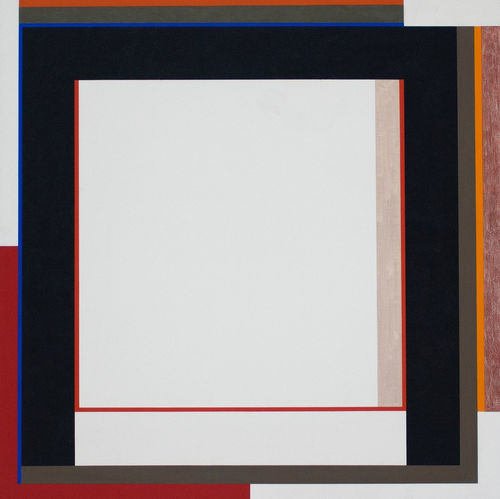
Elaine Lustig Cohen was an American graphic designer, painter, and cultural advocate best known for her pioneering role in shaping modernist graphic design in the United States and for her later work as an abstract artist. Active from the postwar period onward, Lustig Cohen bridged design, fine art, and intellectual life with a practice rooted in clarity, experimentation, and modernist principles.
Born in Jersey City, New Jersey, Lustig Cohen studied briefly at Black Mountain College, where she was exposed to Bauhaus-influenced ideas emphasizing interdisciplinary practice and formal rigor. In the late 1940s, she moved to New York, where she became closely associated with leading figures of American modernism. She married graphic designer Alvin Lustig in 1948 and worked alongside him until his death in 1955, contributing significantly to the development of his influential design studio.
After Alvin Lustig’s death, Lustig Cohen established her own independent career as a graphic designer, producing book jackets, exhibition catalogues, and visual identities for major cultural institutions. Her clients included museums, publishers, and universities, and her work is characterized by bold typography, asymmetrical compositions, and a refined use of color and space. She played a key role in introducing European modernist design principles—particularly those rooted in Bauhaus and Constructivist traditions—to American audiences.
In the 1960s, Lustig Cohen increasingly turned toward painting and collage, developing an abstract visual language that paralleled her design sensibility while allowing greater formal freedom. Her paintings often incorporate geometric shapes, layered forms, and subtle color relationships, reflecting an ongoing engagement with balance, rhythm, and structure. Though distinct from her graphic work, these paintings share the same intellectual discipline and modernist clarity.
Beyond her studio practice, Lustig Cohen was a vital advocate for modern design and architecture. She co-founded the Arthur A. Cohen Design Studio with her second husband, Arthur A. Cohen, and later directed the Architectural League of New York, where she helped shape discourse around contemporary architecture, design, and urbanism. Her writing and curatorial work further expanded her influence within American cultural institutions.
Today, Elaine Lustig Cohen is recognized as a central figure in 20th-century American graphic design and a significant contributor to postwar abstraction. Her work is held in major museum collections, including the Museum of Modern Art, the Metropolitan Museum of Art, and the Cooper Hewitt, Smithsonian Design Museum, affirming her lasting impact across both design and fine art.
