-
 Little Initiation, 1940

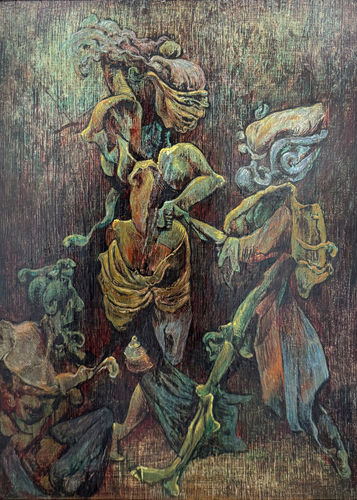
Kurt Seligmann was a Swiss-born American painter, writer, and key figure of Surrealism best known for his enigmatic paintings filled with arcane symbols, ritualistic forms, and references to magic and the occult. Active in Europe and later in the United States, Seligmann played a crucial role in transmitting Surrealist ideas to the American art world during the 1940s.
Born in Basel, Switzerland, Seligmann studied in Paris in the late 1920s, where he became closely associated with the Surrealist circle led by André Breton. His early work reflects the movement’s interest in automatism and dream imagery, but Seligmann soon distinguished himself through a sustained engagement with medieval iconography, alchemy, and esoteric traditions. Rather than pursuing purely psychological Surrealism, he developed a symbolic system rooted in myth, ritual, and historical sources.
Seligmann’s paintings are characterized by flattened pictorial space, intricate linear structures, and a muted yet luminous palette. His compositions often feature robed figures, heraldic devices, and floating emblems arranged in theatrical, stage-like settings. These elements evoke ceremonies and transformations, suggesting a world governed by hidden laws and metaphysical forces. His work stands apart within Surrealism for its intellectual density and deliberate construction.
In 1939, Seligmann emigrated to New York, joining a wave of European Surrealists fleeing World War II. In the United States, he became an influential presence within the émigré avant-garde community and helped introduce American artists to Surrealist ideas. His impact extended beyond painting: in 1948, he published The History of Magic, a widely read and enduring study that further established his reputation as a scholar of esoteric traditions.
Seligmann also played a significant role as a mentor and teacher. He was closely connected to the development of postwar American art, particularly through his influence on younger artists interested in symbolism, myth, and non-rational imagery. While Abstract Expressionism soon dominated the American scene, Seligmann’s work offered an alternative modernism grounded in structure, narrative, and historical continuity.
Today, his work is held in major museum collections, including the Museum of Modern Art, the Solomon R. Guggenheim Museum, and the Philadelphia Museum of Art.