-
 Tama, Mimi, Chan, circa 1950
 -
Cumbres Pass, Colorado, 1956


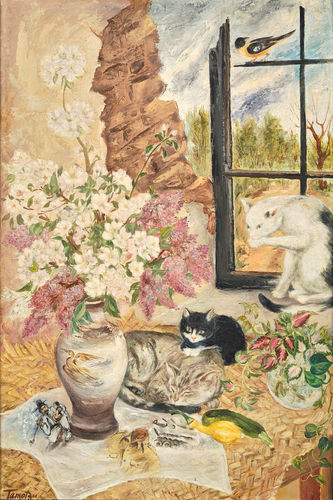
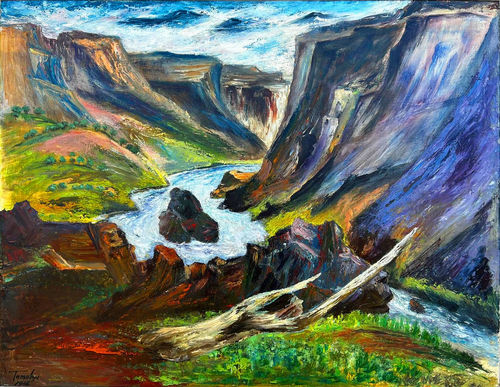
Chuzo Tamotzu was a Japanese American painter best known for his modernist works that bridge early American abstraction and figurative expression. Active primarily in Chicago during the interwar period, Tamotzu developed a distinctive style that blended European modernist influences with a disciplined, introspective approach to form and color.
Born in Japan, Tamotzu immigrated to the United States in the early 20th century and settled in Chicago, where he became part of the city’s progressive artistic circles. He studied at the School of the Art Institute of Chicago, an environment that exposed him to modern European movements including Cubism, Expressionism, and early abstraction. These influences shaped his move away from academic realism toward simplified forms and structural experimentation.
Tamotzu’s paintings encompass portraits, still lifes, and abstract compositions. His work is characterized by flattened space, strong contour lines, and a restrained palette, often conveying a sense of psychological depth and quiet tension. Even in his more abstract works, Tamotzu retained a grounding in figuration, using geometry and color to suggest rather than describe form. This balance places his practice between representation and abstraction, aligning him with broader currents in American modernism while maintaining a highly personal voice.
During the 1920s and 1930s, Tamotzu exhibited regularly in Chicago and gained recognition within local and regional exhibitions. His work was included in shows organized by the Art Institute of Chicago and other cultural institutions, positioning him among a small but significant group of Asian American artists working within modernist frameworks at the time. Despite this visibility, his career unfolded largely outside the dominant narratives centered on New York and Paris.
Tamotzu’s artistic life was cut short by World War II. Following the attack on Pearl Harbor, he was forcibly incarcerated at the Manzanar War Relocation Center, where he died in 1945. This abrupt end to his career contributed to the long neglect of his work in postwar art history, particularly as many Japanese American artists were marginalized or erased from institutional narratives.
Today, Chuzo Tamotzu is recognized as an important early Japanese American modernist. His work and archival materials are held by institutions including the Art Institute of Chicago and the Japanese American National Museum.