-
 Birds of Peace, 1959

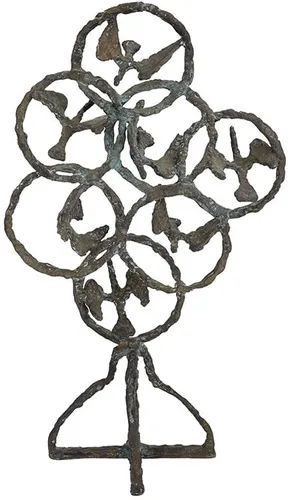
Chaim Gross was a modernist sculptor best known for his dynamic figurative works carved in wood, stone, and bronze. Celebrated for their rhythmic energy and humanistic warmth, Gross’s sculptures combine modernist abstraction with a deep engagement with the human body, reflecting both European avant-garde influences and an enduring commitment to representational form.
Born in what was then Austria-Hungary (now Ukraine), Gross immigrated to the United States in 1921 following the upheavals of World War I. He settled in New York, where he studied briefly at the Educational Alliance Art School and became immersed in the city’s modern art circles.
Largely self-taught as a sculptor, Gross was influenced by European modernism—particularly the work of Constantin Brancusi and Aristide Maillol—while developing a distinctly personal approach grounded in direct carving.
Gross is best known for his wood sculptures, which he favored for their organic qualities and resistance to excessive refinement. Working directly into the material, he produced figures characterized by elongated proportions, flowing contours, and a strong sense of internal movement. His subjects—dancers, acrobats, mothers and children, and reclining nudes—express vitality and balance rather than strict anatomical accuracy. Even when abstracted, Gross’s figures retain a clear emotional and physical presence.
Throughout his career, Gross remained committed to the figure at a time when much of American sculpture was moving toward non-representational abstraction. His work bridges traditional figuration and modernist simplification, positioning him as a key transitional figure in 20th-century American sculpture. In addition to sculpture, Gross produced drawings, prints, and illustrated books, further demonstrating his sensitivity to line and form.
Gross exhibited widely and achieved significant recognition during his lifetime. His work was included in major national and international exhibitions, and he was a visible advocate for modern sculpture in the United States. From 1963 until his death, he lived and worked in a converted firehouse on the Upper East Side of Manhattan, which now serves as the The Renee and Chaim Gross Foundation, preserving his legacy and providing public access to his work.
Today, Chaim Gross is recognized as an important figure in American modernist sculpture. His work is held in major museum collections, including the Museum of Modern Art, the Whitney Museum of American Art, the Metropolitan Museum of Art, and the Smithsonian American Art Museum.