-
 Autumn Hue, Santa Fe, circa 1944-47

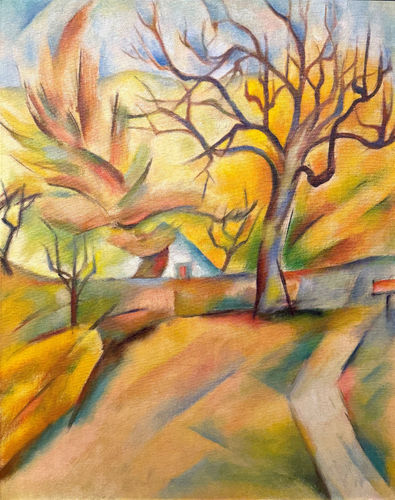
Miki Hayakawa was a Japanese American painter best known for her psychologically resonant portraits and still lifes that merge modernist formal clarity with emotional subtlety. Active primarily on the West Coast and in New Mexico during the interwar period, Hayakawa developed a refined figurative style shaped by European modernism, American realism, and her own cross-cultural experience.
Born in Yamaguchi Prefecture, Japan, Hayakawa immigrated to the United States as a child and was raised in California. She studied at the California School of Fine Arts in San Francisco, where she was exposed to modernist approaches to composition and color. In the late 1920s and early 1930s, she traveled to Europe, spending time in Paris and studying briefly at the Académie Colarossi. There she encountered Post-Impressionism and modern portraiture, influences that would remain central to her work.
Hayakawa is best known for portraits that convey an acute sense of introspection and individuality. Her subjects—often women—are rendered with flattened planes, restrained palettes, and carefully structured compositions. Rather than overt expressionism, Hayakawa favored quiet tension and psychological presence, positioning her work between realism and modernist abstraction. Her still lifes similarly emphasize balance and form, revealing a disciplined, thoughtful approach to pictorial construction.
During the 1930s, Hayakawa became associated with the Santa Fe art community, where she lived and worked for extended periods. The region’s light and landscape subtly informed her palette and sense of space, while its diverse artistic environment supported her modernist sensibility. She exhibited widely during her lifetime, including with progressive galleries and institutions on the West Coast, and received critical recognition in national exhibitions.
Despite this success, Hayakawa’s career was curtailed by the outbreak of World War II and the forced incarceration of Japanese Americans. Although she was not imprisoned herself, the political climate and displacement of her community had a profound impact on her professional opportunities. After the war, her health declined, and she died in relative obscurity in 1953.
In recent years, Hayakawa’s work has been the subject of renewed scholarly and institutional attention, particularly in the context of reassessing modernism through the contributions of women and Asian American artists. Today, Miki Hayakawa is recognized as an important figure in early 20th-century American modernism. Her work is held in major museum collections, including the Smithsonian American Art Museum, the Hirshhorn Museum and Sculpture Garden, and the Los Angeles County Museum of Art.
