-
 Gloucester Harbor, circa 1880

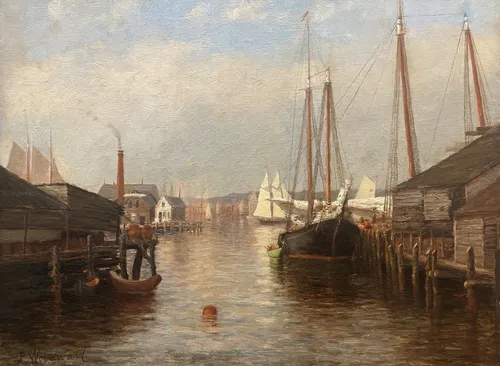
Laura Woodward was an American landscape painter best known for her atmospheric views of Florida and the northeastern United States. Working at the turn of the 20th century, Woodward developed a refined, Tonalist-inflected style that emphasized mood, light, and poetic restraint. She is recognized as one of the most accomplished American women landscape painters of her generation.
Born in New York, Woodward studied at the Art Students League, where she trained under prominent artists including John Henry Twachtman and William Merritt Chase. This academic grounding shaped her disciplined approach to composition and her sensitivity to tonal harmony. While she was active in New York’s art circles, Woodward is most closely associated with Florida, where she spent extended periods working and exhibiting.
Beginning in the 1890s, Woodward became closely connected to St. Augustine and later Daytona, Florida, regions that provided rich subject matter for her work. Her paintings depict rivers, marshes, palmetto groves, and coastal landscapes rendered in muted palettes and softened brushwork. Rather than picturesque description, Woodward focused on atmosphere and emotional resonance, aligning her work with American Tonalism while maintaining a distinctly personal vision.
Woodward achieved notable professional success during her lifetime. She exhibited widely at major venues, including the National Academy of Design, the Pennsylvania Academy of the Fine Arts, and the Art Institute of Chicago. In 1902, she became one of the first women artists elected as an associate member of the National Academy of Design.
After her death in 1919, Woodward’s reputation faded as Tonalism fell out of favor. In recent decades, however, her work has been reassessed and increasingly appreciated for its technical sophistication and historical importance. Today, Laura Woodward is recognized as a key figure in American landscape painting and an important contributor to the history of women artists in the United States.