-
 Untitled, 1960

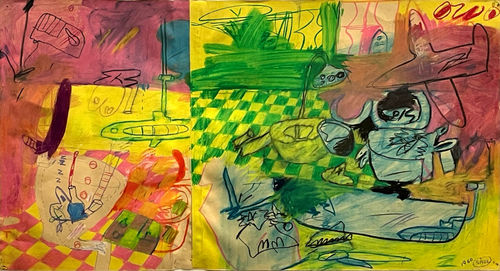
Peter Saul was an American painter best known for his fiercely satirical, politically charged figurative works that combine elements of Pop Art, underground comics, Surrealism, and Expressionism. Over a career spanning more than six decades, Saul developed a singular visual language marked by exaggerated forms, acidic color, and an unflinching engagement with American politics, violence, and popular culture.
Born in San Francisco, Saul studied at the California School of Fine Arts (now the San Francisco Art Institute) before moving to Europe in the late 1950s. He spent extended periods in France, Italy, and the Netherlands, where he worked largely outside the mainstream American art world. During this time, Saul absorbed influences ranging from French comic strips and Old Master painting to contemporary political events, forging a style that stood apart from the dominant movements of Abstract Expressionism and later Minimalism.
Saul’s paintings are immediately recognizable for their grotesque distortions, cartoonish figures, and confrontational imagery. He frequently depicted politicians, historical figures, and cultural icons often in states of physical or moral collapse using satire as a tool for critique. Recurring themes in his work include war, racism, state violence, corruption, and the absurdity of power. While his work has often been provocative and deliberately offensive, it is underpinned by rigorous draftsmanship and a deep engagement with art history.
Although Saul is often associated with Pop Art due to his use of popular imagery, his relationship to the movement was ambivalent. Unlike Pop’s cooler, detached stance, Saul’s work is emotionally charged, aggressive, and overtly critical. This resistance to categorization contributed to his marginalization during certain periods of his career, particularly in the 1960s and 1970s, when his confrontational politics ran counter to prevailing critical tastes.
From the 1980s onward, Saul’s work experienced renewed attention, as scholars and curators reassessed his role as a precursor to later generations of figurative and politically engaged artists. He taught for many years at the University of Texas at Austin, where he influenced younger artists interested in narrative, figuration, and satire.
Saul is recognized as a major figure in postwar American art whose work anticipated contemporary approaches to political painting and graphic figuration. His paintings are held in major museum collections, including the Museum of Modern Art, the Whitney Museum of American Art, and the Art Institute of Chicago.