-
 A Sly Drink at the Camp, 1861-65
 -
John Van Schaick Lansing Pruyn, 1883


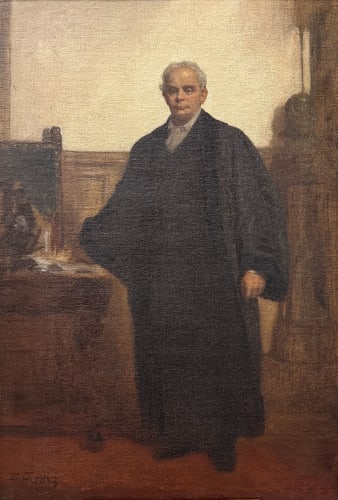
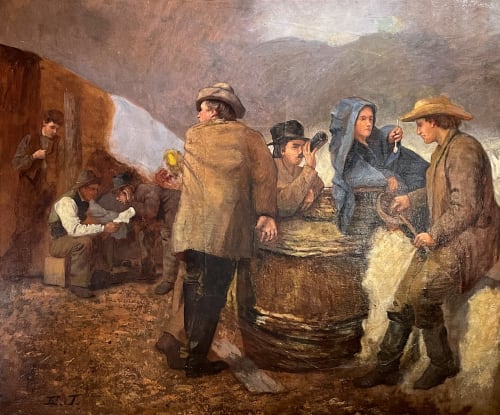
Eastman Johnson was a leading 19th-century American painter best known for his genre scenes depicting everyday life in New England, the American South, and rural communities.
Often referred to as “the American Rembrandt” for his sensitive use of light and shadow, Johnson played a central role in shaping a distinctly American realist tradition.
Born in Lovell, Maine, Johnson initially trained in Boston before traveling to Europe, where he studied in Düsseldorf and The Hague. While abroad, he absorbed the influence of Dutch Old Master painting, particularly its emphasis on domestic interiors, careful observation, and tonal restraint. These influences remained central to his work after he returned to the United States in the late 1850s.
Johnson is best known for intimate interior scenes, portraits, and genre paintings that portray moments of ordinary life with psychological depth and narrative subtlety. His New England subjects, including families gathered around hearths, children at play, and figures absorbed in quiet tasks reflect a deep interest in regional identity and social experience. At the same time, his work often engages with broader cultural themes, including labor, community, and national character.
During the Civil War era, Johnson produced a number of works addressing life in the American South, including scenes depicting enslaved and formerly enslaved individuals. While these paintings are complex and historically situated, they represent some of the most significant visual records of Black life created by a white American artist of the period. Johnson approached these subjects with an unusual degree of attentiveness and individuality, distinguishing his work from more conventional sentimental or caricatured depictions.
Johnson was highly regarded during his lifetime and achieved both critical and commercial success. He was a founding member of the Metropolitan Museum of Art in New York and exhibited widely at major institutions, including the National Academy of Design. His work was collected by leading patrons and museums, securing his reputation as one of the foremost American painters of the 19th century.
Johnson’s paintings are held in major museum collections, including the Metropolitan Museum of Art, the Smithsonian American Art Museum, and the Brooklyn Museum. His work continues to be studied for its technical skill, narrative complexity, and lasting contribution to American genre painting.