-
 Dahlias and Lustre, circa 1925
 -
Byzantine Fountain, Italy, 1921


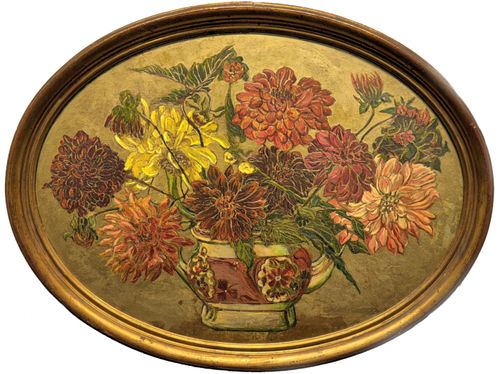
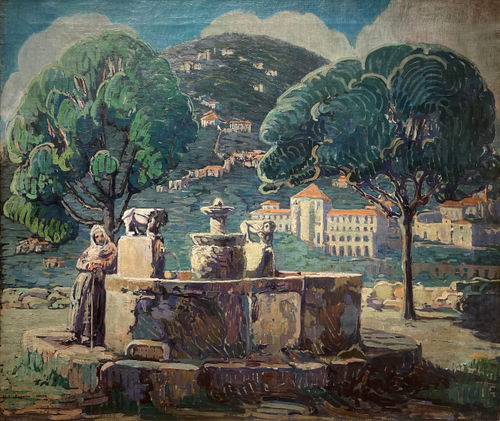
Mary Elizabeth Price was a distinguished American painter closely associated with the Pennsylvania Impressionist movement and one of the most important women artists of her generation. Born in Martinsburg, West Virginia, to a Quaker family, she spent much of her youth on her family’s farm in Solebury Township, Pennsylvania, near New Hope, a region that would become a vibrant art colony in the early 20th century.
Price’s artistic education began at the Philadelphia School of Industrial Arts (now the University of the Arts), where she studied from about 1896 to 1904. She then continued her training at the Pennsylvania Academy of the Fine Arts, studying under prominent painters such as Hugh Breckenridge and Daniel Garber, and took private lessons with William Langson Lathrop, a key figure in the New Hope art community.
Her early career was marked by a solid presence in major exhibitions. Price began showing her work at the Pennsylvania Academy of the Fine Arts as early as 1914 and continued to exhibit there regularly between 1926 and 1943. She also showed at the Corcoran Biennial and the National Academy of Design, where her work was featured sixteen times between 1921 and 1934. In 1927 she was awarded the Carnegie Prize for the best oil painting by an American artist in exhibition, an important recognition of her talent and stature.
Price was a founding member of The Philadelphia Ten, an influential group of women artists who exhibited together from 1921 to 1945. The group provided a critical platform for women painters at a time when they were often marginalized by mainstream art institutions. Through this affiliation, Price helped organize numerous exhibitions and became a strong advocate for women’s visibility in the arts.
Her work is perhaps best known for its decorative floral still lifes, often executed on gilded backgrounds using gold and silver leaf—a technique inspired by early Renaissance art and Japanese influence. These paintings marry a delicate naturalism with a bold decorative sensibility, breathing luminous color and ornate surfaces into traditional subject matter. Price also painted landscapes, genre scenes, and even marine subjects, drawing inspiration from trips abroad to Italy and France and her surroundings along the Delaware River near her home, which she affectionately called Pumpkinseed Cottage.
Beyond her painting, Price was active in art education and community building. In New York she helped found the Greenwich House Pottery and ran art programs for public school children in collaboration with patrons like Gertrude Vanderbilt Whitney in the late 1910s. Later, she was involved with the Phillips Mill Community Association in Bucks County, further fostering artistic exchange in her region.
Mary Elizabeth Price never married and remained dedicated to her art throughout her life. She died in Trenton, New Jersey, at age 87, leaving behind a substantial body of work that continues to be held in museum collections and celebrated for its unique blend of Impressionist influence, decorative richness, and pioneering role for women artists in early 20th-century America.
