-
 Field at Dusk

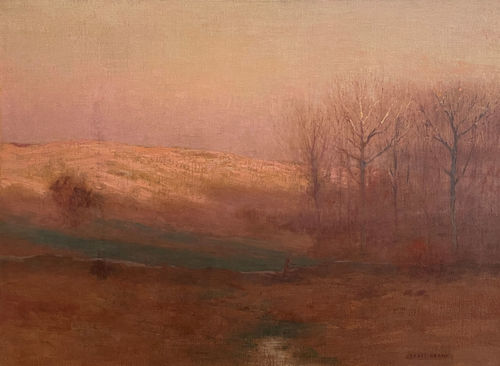
Bruce Crane was an American Tonalist painter best known for atmospheric landscape paintings depicting the countryside of New England and the Catskill Mountains. His work is characterized by muted color palettes, soft brushwork, and an emphasis on mood and tonal harmony rather than descriptive detail.
Born in New York, Crane began his career as an illustrator before devoting himself fully to painting in the late 19th century. He was strongly influenced by George Inness and became closely associated with American Tonalism, a movement that sought to convey emotional and spiritual responses to nature through restrained color and simplified form. Crane’s landscapes frequently depict rolling fields, wooded hills, and seasonal transitions, often rendered in autumnal tones.
Crane was an active member of the Old Lyme Art Colony in Connecticut, one of the most significant artist communities in the United States during the early 20th century. While many artists at Old Lyme embraced Impressionism, Crane remained committed to Tonalism and was regarded as one of the movement’s most consistent practitioners. He exhibited widely during his lifetime, including at the National Academy of Design and the Pennsylvania Academy of the Fine Arts.
Today, Bruce Crane is recognized as an important figure in American Tonalist landscape painting. His works are held in major museum collections, including the Metropolitan Museum of Art, the Smithsonian American Art Museum, and the Brooklyn Museum.